
Over the last few years, inflation in the United States has quietly but steadily reshaped everyday life. From the price of fuel at the pump to monthly rent, electricity bills, groceries, and prescription medications, nearly every basic necessity now costs more than it did just a short time ago. For millions of Americans—especially seniors, people with disabilities, and low-income households—these rising costs have turned routine expenses into constant financial stress.
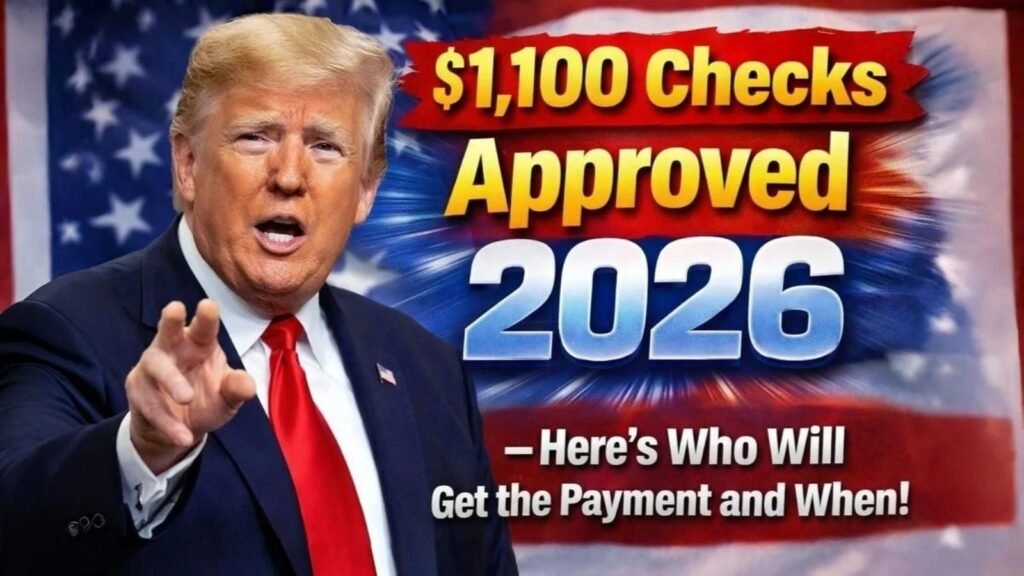
Against this backdrop, the federal government has announced a new financial assistance initiative for 2026: a $1,100 relief payment aimed at helping eligible citizens manage the pressure of a higher cost of living. The announcement has sparked widespread interest and cautious optimism, as many households are eager to understand who qualifies, when the payment will arrive, and how it will be delivered.
Unlike long-term benefit programs, this initiative is structured as a one-time payment, designed to provide immediate financial breathing room. For families already stretching every dollar, the $1,100 relief payment could make a meaningful difference during a challenging economic period.
Brief Overview of the Program: Who Is Managing the $1,100 Relief Payment?
The $1,100 relief payment program is being jointly administered by the U.S. Treasury Department and the Internal Revenue Service (IRS). Under official government documentation, it is referred to as part of the Direct Deposit Checks 2026 initiative. The purpose of involving these agencies is to ensure accurate eligibility verification, efficient processing, and secure distribution of funds.
One of the defining features of this program is its reliance on existing government records. Rather than requiring people to complete lengthy applications, the IRS and other federal agencies will use already-available tax and benefit data to determine eligibility. This approach helps speed up the process and reduces administrative barriers for those who need assistance most.
For individuals with active bank information on file, the $1,100 relief payment will be deposited directly into their accounts. Those without direct deposit arrangements will receive the payment via a mailed paper check. The goal is to deliver funds quickly, securely, and with minimal effort required from recipients.
Why the Government Introduced the $1,100 Relief Payment
The introduction of the $1,100 relief payment did not happen in isolation. Federal officials have acknowledged that inflation has had a disproportionate impact on people living on fixed or limited incomes. While wages have increased in some sectors, many Americans—particularly retirees and benefit recipients—have not seen income growth that keeps pace with rising prices.
Housing costs have climbed in both urban and rural areas. Energy bills have surged, especially during peak heating and cooling seasons. Food prices remain volatile, and healthcare expenses continue to strain household budgets. In response to these pressures, the government determined that a targeted, one-time financial assistance payment could help stabilize vulnerable households.
Importantly, the $1,100 relief payment is classified as tax-free assistance. It does not need to be repaid, and it will not reduce or interfere with other federal or state benefit programs. This ensures that recipients can use the funds without fear of losing existing support.

Who Is Eligible for the $1,100 Relief Payment?
Not every American will receive the $1,100 relief payment. The program is specifically designed for individuals and families most affected by rising living costs. Eligibility is based on a combination of benefit status, age, income level, and federal records.
Individuals currently receiving Supplemental Security Income (SSI), Social Security Disability Insurance (SSDI), or Veterans Affairs (VA) disability benefits are automatically considered eligible. These groups are among the most financially vulnerable and are prioritized under the program.
Senior citizens aged 65 and older also fall within the core eligibility group, particularly those living on fixed retirement incomes. Low-income individuals and families with a valid Social Security Number (SSN) are included as well, provided their financial information is on file through recent federal tax returns.
Eligibility determinations will primarily rely on data from 2023 and 2024 federal tax filings, as well as records maintained by the Social Security Administration and the VA. One of the most reassuring aspects of the $1,100 relief payment is that no separate application is required. If you qualify, the payment will be issued automatically.
When Will the $1,100 Relief Payment Be Sent?
According to preliminary government guidance, distribution of the $1,100 relief payment is scheduled to begin in November 2026. Payments will be released in phases to ensure smooth processing and avoid system overload.
Direct deposit recipients will be the first to receive their funds. For those with bank account information already on file, deposits are expected to start appearing in early November 2026. Paper checks will follow later in the month, with most mailed payments expected to arrive by the end of November.
If any delays occur due to verification issues or mailing logistics, officials have stated that all eligible payments should be completed by the final weeks of November 2026. Individuals who previously received stimulus payments or Social Security benefits through direct deposit can expect the same delivery method for the $1,100 relief payment.
What You Need to Do to Receive the Payment Smoothly
One of the strongest advantages of the $1,100 relief payment program is its simplicity. Most eligible recipients will not need to take any action at all. However, ensuring that your information is accurate can help prevent unnecessary delays.
If you receive federal benefits or have filed recent tax returns, it is important to confirm that your bank account details are current. Even a small error in account numbers can result in rejected deposits. For those expecting a paper check, keeping your mailing address up to date is essential.


To check your payment status or confirm your information, always use official government websites such as IRS.gov, SSA.gov, or VA.gov. If you have not received any updates by mid-2026, contacting the appropriate agency directly is recommended.
The Broader Goal Behind the $1,100 Relief Payment
While the $1,100 relief payment provides direct financial assistance, its purpose goes beyond money alone. Government officials have emphasized that the initiative is part of a broader effort to promote economic stability and dignity for citizens facing financial strain.
Rising inflation has forced many households to make painful choices—cutting back on food quality, delaying medical care, or falling behind on rent and utilities. The $1,100 relief payment is intended to reduce these pressures, even if temporarily.
By helping families cover essential costs, the government aims to prevent deeper financial crises, such as evictions, untreated health issues, or reliance on high-interest debt. In this sense, the program serves both humanitarian and economic stability goals.
Why This $1,100 Relief Payment Is Considered Special
Several factors make the $1,100 relief payment stand out compared to other assistance programs. First, it is completely tax-free, meaning recipients do not have to report it as income. Second, it is a one-time payment with no repayment requirement.
The direct deposit system ensures faster delivery and reduced risk of lost or stolen checks. Most importantly, the program is targeted—not universal—focusing on individuals and families who are most affected by rising costs.
At a time when financial stress is widespread, the $1,100 relief payment arrives as a focused response to immediate needs rather than a broad, unfocused initiative.
Staying Alert: Avoiding Scams and Misinformation
Whenever a government payment is announced, scammers quickly attempt to exploit public interest. Fake emails, text messages, and phone calls claiming to help people access the $1,100 relief payment have already begun circulating.
It is crucial to remember that government agencies will never ask for personal information through unsolicited messages. Do not share your Social Security number, banking details, or personal data with anyone claiming to “process” your payment. Official updates will always come from verified government websites.

Conclusion: Financial Relief at a Critical Time
The $1,100 relief payment for 2026 represents more than a simple cash deposit. For millions of Americans struggling with rising living costs, it offers reassurance that their financial challenges are being recognized at the highest levels of government.
While it may not solve long-term economic issues, this one-time assistance can help families cover essentials, reduce stress, and regain a sense of stability. By keeping personal information up to date and relying only on official sources, eligible individuals can ensure they receive their payment without complications.
In an era of economic uncertainty, the $1,100 relief payment stands as a practical step toward easing immediate hardship and restoring confidence for those who need it most.
FAQs
Q. What is the $1,100 relief payment for 2026?
It is a one-time, tax-free financial assistance payment approved by the U.S. government to help eligible citizens cope with rising living costs.
Q. Who qualifies for the $1,100 relief payment?
Eligible recipients include SSI, SSDI, and VA beneficiaries, seniors aged 65 and older, and low-income individuals with a valid SSN.
Q. Do I need to apply to receive the $1,100 relief payment?
No. Payments will be issued automatically based on existing IRS, SSA, and VA records.